Director: Christopher Nolan
Writer(s): Nikolaj Frobebenius
Genre: Crime, Drama, Thriller.
Release Date: 30th August 2002.
In contrast to Taxi Driver the sound here is used to establish the genre.Before we see anyhting the music seems to creep up on us. The violins set a very sombre, depressing atmosphere that reminded me of death or funerals. The blurred out diagetic sounds that we hear is Nolan's attempt at pulling the audience in to the scene. It sounds as if we are just on the edge of sleep (as the character is). this goes with the title "Insomnia" The sudden jolt in music then "wakes" us up as it goes with the movement of the plane. The music and atmosphere are also reflected by the landscape which is very typical of Hitchcock, like in North by Northwest. it is very baron, plain and uninviting, which could be a hint at what is going to happen later on in the film.
The music that is playing becomes the films "theme". It does not actualy stop throughout the whole opening, just gets quieter. This is showing that the Detective is carrying parts of his city ife into this small town. this is very similar to Scorcese's technique in Taxi Driver.
Wednesday, October 22, 2008

Sound- Taxi Driver
 Taxi Driver:
Director: Martin Scorcese
Release Date: 8th February 1976
Writer: Paul Schrader
Genre: Crime, Action, Thriller
In the opening scene of Taxi Driver music is mainly used to establish Robert De Nero's character. The big drum rolls as the camera moves around gives the taxi a real sense of importance and dominance. This music also seems very "military" which relates to the characters military background. The music then switches to a very sultry Jazz sounding score which then reflects New York city and the "seedy" sort of atmosphere. This shows the contrast between the characters city life and his previous military life. I think how the music changes when looking at the character shows that perhaps he may have split personalities?
The low drum beat symbolizes a heart beat. While the character is walking along the streets of New York there is a sort of "snooping" music which again goes with the seedy atmosphere. it is also as if he is inspecting the streets which goes along with his monologue where he is saying how disgusted he is at everything he is seeing.
The opening credits are very similar to Psycho by Hitchcock. The intense music reaches out to the audience and demands their attention immediately.
Wednesday, October 8, 2008
La Haine (The Hate)
Director:Mathieu Kassovitz
Writer:Mathieu Kassovitz
Release Date:17th November 1995 (UK) 31st May 1995 (France)
Genre:Crime, Drama.
Cinematography
Writer:Mathieu Kassovitz
Release Date:17th November 1995 (UK) 31st May 1995 (France)
Genre:Crime, Drama.
Cinematography
- Begins with tilt shot lookiong up at sky. Clever editing which show time passing by (clouds moving very fast)
- Steady cam moving quite slowly, contradicts the sense of realism that Kassovitz is trying to create but also highlights the significance of the scene. Makes the audience remember it.
- The fluidity of the camera movement creates a sense of realism. The scene where the camera is following the group is particularly good for showing this. The shot goes on for a very long time with no cuts. This makes the spectator feel as if they are the fourth member of the group.
- Shallow/Narrow depth of field.Background slightly blurred. shows that we should be concentrating on the foreground, perhaps it has some importance?
- Shot from behind the character adds to the sense of realism as that is what we would be looking at if we were in the film. Relates to Guss Van Sant's "Elephant". it is all to create a sense of realism as if we were actually there within the film.
- The shot from behind also gives a sense of mystery as we cannot see the faces. Although this does make us concentrate on the conversation as we don't have alot else to look at. I think this is another way of stressing the importance of a certain factor in the film, in this case their conversation.
- The colour in this film is quite specific to the setting and genre. it is a gritty and at times violent film, so the black and white colour is good for showing the rawness of the setting.
Wednesday, October 1, 2008
Psycho
Director: Alfred Hitchcock
Writers: Robert Bloch (novel)
Joseph Stefano (screenplay)
Release Date: 16th June 1960 (USA)
The first shot, an extreme long shot of the city creates a real sense of atmosphere. It also makes the two characters who are first seen seem very insignificant, like it is two tiny characters inside this huge city. The zooming into the window also creates a rela sense of voyeurism. I think Hitchcock is doing this to really involve the spectator and make the camera "our eyes". The use of a side-shot, or twin-shot showing the man and woman at the beginning is used to disguise the main character as they both seem to have equal importance. The focus on the money on the bed also shows how this is an important factor in the film.
Writers: Robert Bloch (novel)
Joseph Stefano (screenplay)
Release Date: 16th June 1960 (USA)
The first shot, an extreme long shot of the city creates a real sense of atmosphere. It also makes the two characters who are first seen seem very insignificant, like it is two tiny characters inside this huge city. The zooming into the window also creates a rela sense of voyeurism. I think Hitchcock is doing this to really involve the spectator and make the camera "our eyes". The use of a side-shot, or twin-shot showing the man and woman at the beginning is used to disguise the main character as they both seem to have equal importance. The focus on the money on the bed also shows how this is an important factor in the film.
Monday, September 29, 2008
Fargo Analysis
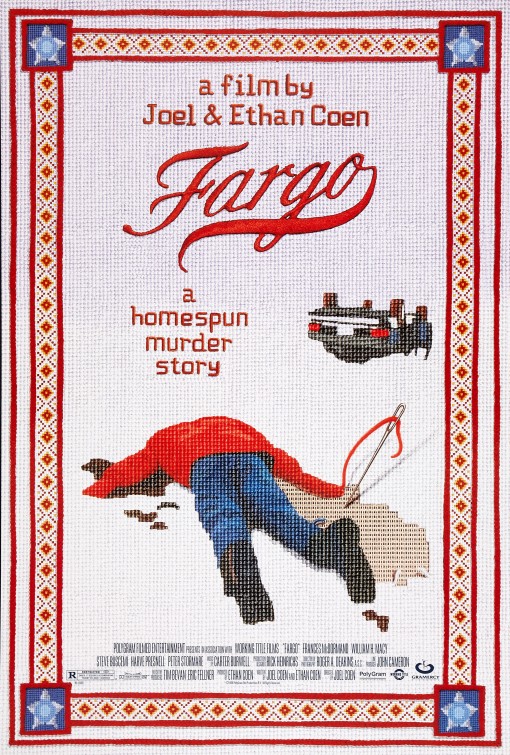
Director: Joel Cohen
Writers: Joel Cohen and Ethan Cohen
Release Date: 31st May 2006
Genre: Crime, Drama, Thriller.
We learn alot about Lundergaards character by observing his body language. For example, the scene where he tells his father-in-law that his wife has been kidnapped we see him rehearsing how to tell him which shows us that he obviously has some involvement.
Cars are made to represent characters in the film. For example, bright lights breaking the dark horizon represent the witnesses prying eyes in the scene of the first murder. Also the crashed car upside down represents the helplessness of the victims along with the red brake lights in the snow which shows bloodshed. Cohen also uses sound to provoke tension amongst the spectator. For example the beeping sound in the car when the first murder occurs is consistent throughout the film and it almost acts as a warning to the audience that something sinister is about to happen.
The black, dark landscape that surrounds the first murder scene represents death as the coulour black has connotations of evil and death. The next scene then shows Margie disappearing in her police car into a pure white landscape. Not only does this show peace, innocence and light, but it also shows how she doesn't know what she is in for as she fades away into the distance.
The landscape is also used to create tension. The blizzard like conditions prevent the spectator from seeing too far into the distance so we never know what is "around the corner" however art the end of the film when all is revealed it becomes alot clearer so I think that the clouded landscape represents Margie's mind as she is struggling to work the whole thing out.
Black is seen again when we see the Wife for the first time and her head is covered by a black cloth, showing death. We also see it again when Gerry's father-in-law is going to give the kidnappers their money. As he is driving his face fades into blackness repeatedly, I think this shows how the darkness is over coming him which it does as he tries to kill the kidnapper.
The flat, open landscape shows isolation, loneliness and gives the audience a real feeling of helplessness. This is alot like Hitchcock's technique in North by Northwest.
The costume also shows alot about Gerry. Throughout the film he wears very bland clothes, reflecting his bland typical car salesman job. Also, at the end of the film when he is finally caught by the police he is in his pyjamas. I think this shows his vulnerability and how everything has fallen apart for him.
Wednesday, September 24, 2008
Zulu
Director: C.Y. Endfield
Writer: John Prebble
Release Date: 22nd January 1964 (UK)
17th June 1964 (USA)
Genre: Action, Drama, Historical.
Plot: Outnumbered British soldiers from different military backgrounds do battle with Zulu warriors at Rorkes Drift
Writer: John Prebble
Release Date: 22nd January 1964 (UK)
17th June 1964 (USA)
Genre: Action, Drama, Historical.
Plot: Outnumbered British soldiers from different military backgrounds do battle with Zulu warriors at Rorkes Drift
- Sounds of Zulu chants are very haunting, intimidating. Shows the vast numbers of them and how outnumbered the British soldiers are.
- Gunshots echoe around the land, shows the open space. Like in North By Nothwest, vast baron landscape, nowhere to hide.
- Use of a longshot to show a house in the middle of the desert shows how the landscape reflects characters. A tiny house amongst vast open plane. Again like in North By Northwest, tiny bus amongst huge baron desert.
- Landscape reflects characters!!
- An extreme longshot shows more Zulus hiding in bushes. Raises tension as we know there are more to come but the British do not.
Atonement- Mise En Scene
Director: Joe Wright
Writers: Ian McEwan (novel)
Christopher Hampton (screenplay)
Realease Date: 7th September 2007 Uk
Genre: Drama, fantasy, mystery, romance, war.
Writers: Ian McEwan (novel)
Christopher Hampton (screenplay)
Realease Date: 7th September 2007 Uk
Genre: Drama, fantasy, mystery, romance, war.
- The use of red in this film is very important and it is a great example of how colours can represent feelings and emotions. For example in the scene with the red roses I think red is used to represent love and how his love for her is being trampled. The colour is then consistent throughout the film and is used alot which shows that love is an underlying theme of the film.
- The scene in the cinema is good for showing how events within the scene can show themes, issues, or emotions. For example, when Robbie (James McAvoy) is stood infornt of the cinema screen he appears to be a small character infront of this huge love story. I think that this shows how he is inferior in the story and that he is totally overcome by his love for Cecilia.
- The buildings and surroundings are very good for showing the characters class and the time period. For example, Robbie is wearing a suit which makes the audience assume he is innocent as this is very upper class attire for men of that era. The buildings also have very elegant and wealthy looking design which shows the two characters' social class. It also show the time period as architecture of this sort was very typical of that time period.
Subscribe to:
Posts (Atom)